
Quick answer
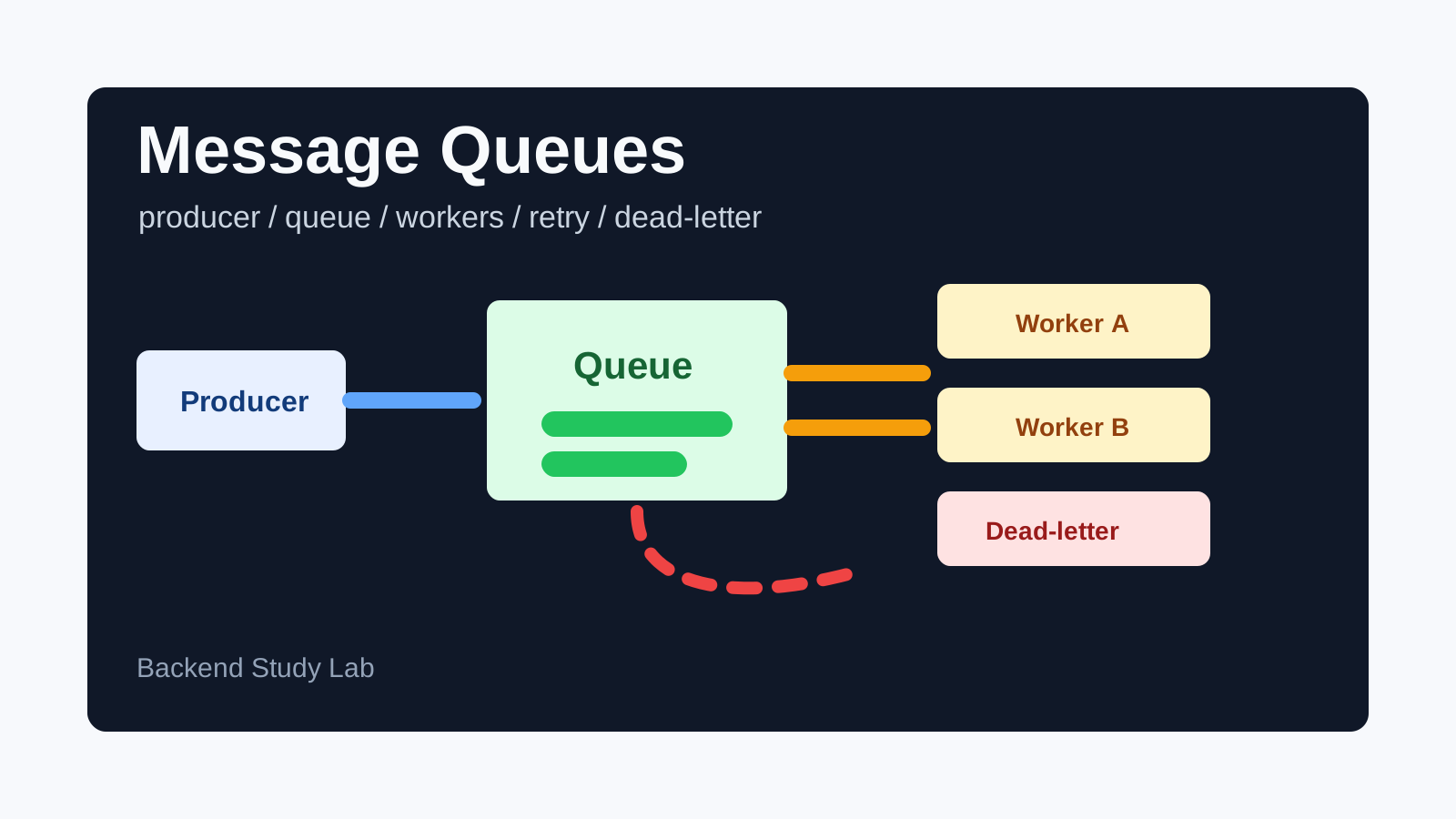
A message queue lets one part of a system send work to another part asynchronously. A producer publishes a message, the queue stores it, and a consumer processes it later.
Queues help backend systems smooth traffic spikes, decouple services, retry failed work, and move slow tasks out of user-facing request paths.
Why queues matter
Without a queue, a request may need to do everything before returning:
create order -> charge payment -> send email -> update analytics -> call warehouseIf every step happens inline, the user waits longer and the request is more likely to fail because one dependency is slow.
With a queue, the API can perform the required synchronous work, enqueue follow-up tasks, and return sooner:
create order -> enqueue email job -> enqueue warehouse sync -> return responseThe background consumers handle the rest.
Producers, queues, and consumers
The basic parts are:
| Part | Role |
|---|---|
| Producer | Publishes messages to the queue. |
| Queue | Stores messages until consumers can process them. |
| Consumer | Reads messages and performs the work. |
| Acknowledgment | Tells the queue a message was processed successfully. |
A message is usually a small JSON payload or event shape:
{
  "type": "order.created",
  "orderId": "ord_123",
  "accountId": "acct_42",
  "createdAt": "2026-06-29T12:00:00Z"
}
The message should include stable identifiers, not a huge copy of every related object.
At-least-once delivery
Many queues provide at-least-once delivery. That means a message should be delivered, but it may be delivered more than once.
Duplicates can happen when:
- A consumer finishes work but crashes before acknowledging.
- The queue visibility timeout expires.
- The producer retries publishing after an uncertain failure.
- A network issue hides the result of an acknowledgment.
Because duplicates are normal, consumers should be idempotent. Read Idempotency in APIs Explained for the broader retry-safety pattern.
To make the queue path reliable end to end, persist publication intent with the Transactional Outbox Pattern, choose acknowledgment boundaries with Message Delivery Semantics, make handlers duplicate-safe with the Idempotent Consumer Pattern, and operate poison-message recovery with a Dead Letter Queue.
Retries
Queues are useful because failed work can be retried.
A consumer might fail because:
- A downstream API timed out.
- The database was temporarily unavailable.
- The message payload was invalid.
- A bug caused an exception.
Transient failures can be retried with backoff. Permanent failures should not be retried forever.
attempt 1 -> fail -> wait 10 seconds
attempt 2 -> fail -> wait 60 seconds
attempt 3 -> fail -> send to dead-letter queue
Backoff prevents a broken dependency from being hammered by immediate retries.
Dead-letter queues
A dead-letter queue stores messages that could not be processed after the retry policy.
Dead-letter queues help teams inspect failures without losing the message. They are also useful for alerting, manual repair, and replay after a bug is fixed.
A message in a dead-letter queue should include enough metadata to debug it:
- Original message payload.
- Error type or reason.
- Attempt count.
- First failure time.
- Last failure time.
- Consumer name or version.
Do not treat a dead-letter queue as a place messages can disappear forever. It needs monitoring.
Ordering
Message ordering is more subtle than it looks.
Some queues guarantee ordering only within a partition, group, or shard. Others make no strong ordering guarantee. Even when a queue preserves order, retries can still make processing appear out of order.
If ordering matters, design for it explicitly:
- Use a partition key such as account ID or order ID.
- Store sequence numbers.
- Make updates conditional on expected state.
- Use optimistic locking for shared records.
Read Optimistic Locking Explained for one way to protect state transitions from stale updates.
Queue vs event stream
Queues and event streams are related but not identical.
| Pattern | Typical use |
|---|---|
| Queue | Work distribution where each message is processed by one consumer group. |
| Event stream | Durable event log where multiple consumers may independently read events. |
A queue is a good fit for jobs like sending emails or processing uploads. An event stream is a better fit for analytics pipelines, audit logs, or multiple downstream projections.
What to put in a message
Good messages are small, explicit, and versionable.
Include:
- Event or job type.
- Stable IDs.
- Minimal context needed to process.
- Creation timestamp.
- Schema or version when useful.
- Idempotency key or event ID.
Avoid including secrets, access tokens, or large object graphs. The consumer can fetch fresh data by ID when needed.
Common mistakes
The first mistake is assuming a queue means exactly-once processing. Most systems should be designed for duplicate delivery.
The second mistake is putting slow, failing work into a queue without monitoring. A queue can hide latency until the backlog becomes an incident.
The third mistake is retrying invalid messages forever. Bad payloads need validation and dead-letter handling.
The fourth mistake is ignoring consumer idempotency. A duplicate email, duplicate charge, or duplicate state transition is still a real bug.
Practical backend checklist
Before adding a queue:
- Decide which work must stay synchronous.
- Define the message schema and versioning plan.
- Add stable event IDs or idempotency keys.
- Make consumers safe for duplicate messages.
- Configure retry and dead-letter behavior.
- Monitor queue depth, age, failures, and retry rate.
- Document replay behavior.
For cross-service diagnosis, Distributed Tracing and Context Propagation separates durable message identity from consumer attempts, while Production Incident Troubleshooting verifies queue age and delayed work before closing an incident.
When producers outpace consumers, Backpressure, Bounded Queues, and Flow Control turns capacity, demand, expiry, and rejection into an explicit contract. If backlog growth joins wider service saturation, Production Overload Troubleshooting guides mitigation and recovery across both request and asynchronous boundaries.
Related reading
Read Idempotency in APIs Explained for duplicate-safe operations and Rate Limiting in APIs Explained for controlling retry pressure. For state conflicts during async processing, read Optimistic Locking Explained. Use the UUID Generator for local event ID and idempotency key examples.